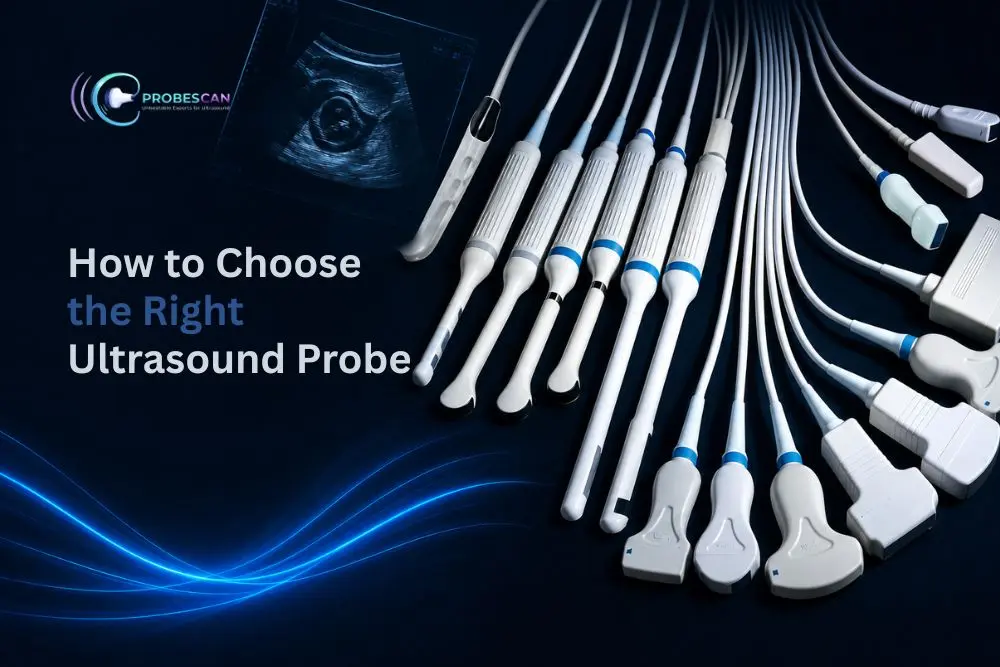
Choosing the right ultrasound probe is an important decision for hospitals, clinics, diagnostic centres, and other healthcare facilities. The probe, also known as a transducer, directly affects image quality, examination capabilities, workflow, and the overall performance of an ultrasound system.
With different probe types, frequencies, designs, and applications available, selecting the right option can sometimes be challenging. The best ultrasound probe is not necessarily the most expensive one—it is the probe that matches your clinical requirements, ultrasound system, patient needs, and workload.
This guide explains the key factors healthcare facilities should consider when choosing an ultrasound probe.
What Is an Ultrasound Probe?
An ultrasound probe is a handheld device that sends and receives high-frequency sound waves to create images of structures inside the body. The probe converts electrical energy into ultrasound waves and receives returning echoes, which the ultrasound system processes into diagnostic images.
Different probes are designed for different applications. Their shape, frequency range, footprint, depth of penetration, and scanning capabilities can vary significantly.
Choosing the correct probe can therefore improve examination efficiency and help clinicians obtain suitable images for their diagnostic requirements.
Why Choosing the Right Ultrasound Probe Matters
The right probe can make a significant difference to the usability and performance of an ultrasound system.
A suitable probe can provide:
Better image quality
Appropriate imaging depth
Improved examination efficiency
Greater patient comfort
Better access to specific anatomical areas
Compatibility with required clinical applications
More reliable day-to-day performance
On the other hand, using an unsuitable probe may make certain examinations difficult or result in inadequate imaging for the intended application.
1. Identify Your Clinical Applications
The first step is to determine what examinations the healthcare facility performs most frequently.
Different clinical applications require different probe characteristics.
For example:
General abdominal imaging commonly requires a probe capable of imaging deeper structures.
Vascular examinations often require a high-frequency linear probe for detailed imaging of superficial vessels.
Cardiac examinations require probes designed for rapid imaging through the chest.
Obstetric and gynaecological examinations may require specialised convex or endocavitary probes.
Musculoskeletal examinations often benefit from high-frequency linear probes.
Small-parts imaging generally requires high-frequency imaging for superficial structures.
Before purchasing a probe, make a list of the examinations your facility performs and identify which probe type is appropriate for each application.
2. Understand the Different Types of Ultrasound Probes
Ultrasound probes come in several designs. Understanding their typical applications can help you narrow down your options.
Linear Probe
Linear probes typically have a rectangular footprint and operate at relatively high frequencies.
They are commonly used for superficial structures such as:
Blood vessels
Muscles and tendons
Thyroid
Breast
Soft tissues
Small parts
Their higher frequencies provide detailed images of structures close to the skin.
Convex Probe
Convex probes have a curved footprint and are commonly used for deeper imaging.
Typical applications include:
Abdominal examinations
Obstetric imaging
General imaging
Pelvic examinations
Their wider field of view and ability to image deeper structures make them useful for many general-purpose applications.
Phased-Array Probe
Phased-array probes have a small footprint and are particularly useful where access is limited.
They are commonly associated with:
Cardiac imaging
Emergency examinations
Thoracic imaging
Intercostal scanning
Their small footprint allows clinicians to scan between the ribs while obtaining a relatively wide field of view at depth.
Endocavitary Probe
Endocavitary probes are designed for internal examinations and include applications such as:
Transvaginal imaging
Transrectal imaging
These probes are designed specifically for close-range imaging of internal structures.
3D/4D Probe
3D and 4D probes can capture volumetric ultrasound information and are commonly used in applications such as obstetric imaging and other specialised examinations.
When selecting a 3D/4D probe, healthcare facilities should consider both imaging requirements and the additional maintenance and technical considerations associated with these specialised probes.
TEE Probe
Transesophageal echocardiography (TEE) probes are specialised probes used for cardiac imaging through the oesophagus.
They are complex medical devices and should be selected based on the specific ultrasound system, clinical application, compatibility, and service support available.
3. Consider the Required Frequency
Probe frequency is another important factor.
In general, higher-frequency probes provide greater detail for superficial structures but have less penetration, while lower-frequency probes can penetrate deeper but may provide less detailed images of superficial structures.
The appropriate frequency depends on the examination.
For example:
High frequency → superficial structures
Medium frequency → general imaging
Lower frequency → deeper structures
Many modern probes offer a frequency range, allowing clinicians to adjust imaging according to the examination and patient.
4. Check Ultrasound System Compatibility
One of the most important considerations is compatibility.
Not every ultrasound probe works with every ultrasound system. Even probes from the same manufacturer may have different connectors, technologies, or compatibility requirements.
Before purchasing a probe, verify:
Ultrasound system manufacturer
System model
Probe model
Connector type
Supported applications
Frequency range
Software or system compatibility
Providing the exact ultrasound system model to the supplier can help avoid purchasing an incompatible probe.
5. Consider Patient and Examination Requirements
Patient characteristics can also influence probe selection.
For example, imaging larger or deeper anatomical areas may require a probe with appropriate penetration and field of view. Superficial examinations may require higher-frequency imaging.
Healthcare facilities should consider the range of patients they treat rather than selecting a probe based on a single examination type.
6. Think About Your Facility's Workload
The expected workload should also influence your decision.
A busy diagnostic centre may need probes that can withstand frequent daily use. Hospitals with multiple departments may require several probe types to support different specialties.
When selecting equipment, consider:
Number of examinations per day
Frequency of probe use
Number of ultrasound systems
Departments using the equipment
Expected equipment lifespan
Availability of backup probes
For facilities where ultrasound is critical to daily operations, having suitable backup equipment can also help reduce downtime if a probe requires repair or maintenance.
7. Consider Probe Durability
Ultrasound probes are regularly handled, cleaned, disinfected, transported, and connected to ultrasound systems. Repeated use can eventually contribute to wear.
Pay attention to the probe's:
Cable construction
Connector quality
Housing
Acoustic lens
Strain relief
Overall build quality
Proper handling and maintenance are equally important for extending probe life.
Even a high-quality probe can develop problems if it is repeatedly dropped, pulled by its cable, exposed to inappropriate cleaning chemicals, or stored incorrectly.
8. Consider Cleaning and Disinfection Requirements
Different ultrasound examinations may require different cleaning and disinfection procedures.
This is particularly important for probes used in procedures where infection-control requirements are higher.
Before purchasing, ensure that the probe's approved cleaning and disinfection requirements are suitable for your facility's clinical workflow.
Following the manufacturer's instructions is essential. Using inappropriate chemicals or cleaning methods can damage the probe's acoustic lens, housing, cable, or other components.
9. Consider Repair and Maintenance Support
The purchase price should not be the only factor you consider.
Before choosing a probe, investigate the availability of:
Technical support
Preventive maintenance
Diagnostic testing
Repair services
Replacement parts
Replacement probes
Warranty or service coverage
A probe may be an essential part of your clinical workflow. If it develops a fault, access to reliable repair and technical support can help reduce equipment downtime.
This is particularly important for hospitals and diagnostic centres that depend heavily on ultrasound imaging.
If you are looking ultrasound probe repair in UAE, Probescan is here to serve you with best results.
10. New vs Refurbished Ultrasound Probes
Healthcare facilities may also need to decide between purchasing a new probe and a professionally refurbished probe.
A new probe may be appropriate when:
The facility requires a new device
A specific model is needed
Budget allows for new equipment
Manufacturer support is important
A professionally refurbished probe may be considered when:
Budget is a major consideration
A suitable refurbished model is available
The probe has been properly inspected and tested
Reliable service or warranty support is available
If considering a refurbished probe, ask about its condition, testing process, repair history, compatibility, and available support before purchasing.
11. Consider the Total Cost of Ownership
The purchase price is only one part of the overall cost.
Healthcare facilities should also consider:
Maintenance
Repairs
Replacement parts
Downtime
Cleaning requirements
Expected service life
Availability of technical support
Future replacement requirements
A slightly more expensive probe with reliable technical support and a longer expected service life may provide better value than a cheaper option with limited support.
12. Common Mistakes to Avoid
Healthcare facilities can avoid unnecessary costs and compatibility problems by avoiding some common mistakes.
Buying Based Only on Price
The cheapest probe may not provide the right performance or long-term value for your facility.
Not Checking Compatibility
Always confirm the exact ultrasound system and probe compatibility before placing an order.
Choosing One Probe for Every Application
Different examinations often require different probe designs and frequencies. A general-purpose probe may not be suitable for specialised applications.
Ignoring After-Sales Support
Consider what happens if the probe develops a fault after purchase. Reliable repair and technical support can be important for reducing downtime.
Neglecting Maintenance
Regular inspection, appropriate cleaning, careful handling, and preventive maintenance can help extend probe service life.
How Probescan Can Help
Selecting the right ultrasound probe involves more than choosing a model from a catalogue. Healthcare facilities should consider clinical requirements, system compatibility, probe condition, expected workload, and long-term technical support.
Probescan, based in Dubai, UAE, provides ultrasound probe repair, diagnostics, evaluation, maintenance, and supply services for healthcare facilities.
With more than 22 years of experience, Probescan's certified biomedical engineers help hospitals, clinics, and diagnostic centres with professional probe evaluation and technical support.
Whether you are purchasing a new probe, considering a replacement, or deciding whether an existing probe should be repaired, professional technical guidance can help you make a more informed decision.
Final Thoughts
Choosing the right ultrasound probe starts with understanding your healthcare facility's clinical needs. Consider the application, probe type, frequency, system compatibility, patient requirements, workload, durability, maintenance needs, and long-term support before making a decision.
A well-selected probe can support efficient imaging workflows and help healthcare professionals obtain appropriate diagnostic images. Just as importantly, choosing a supplier or service provider with reliable technical support can help protect your investment over the long term.
If you need assistance with ultrasound probe supply, diagnostics, repair, or maintenance in the UAE, Probescan can help you evaluate your requirements and identify an appropriate solution.
Contact Probescan
Location: Dubai, UAE
Phone: +971 04 451 4824
Email: support@probescanglobal.com